
Fee alerts save money only if they change behavior. A broker fee alert app with push notifications is easy to install and easier to ignore, so the question worth asking is narrower: which fees move often enough, and cost enough when they move, to deserve an alert? Start with the fee an active trader pays most often, the options contract fee, because our dataset of 50 US brokerages records it for 29 of them and the spread is wider than the $0 commission headlines suggest.
The fee an alert app should watch first
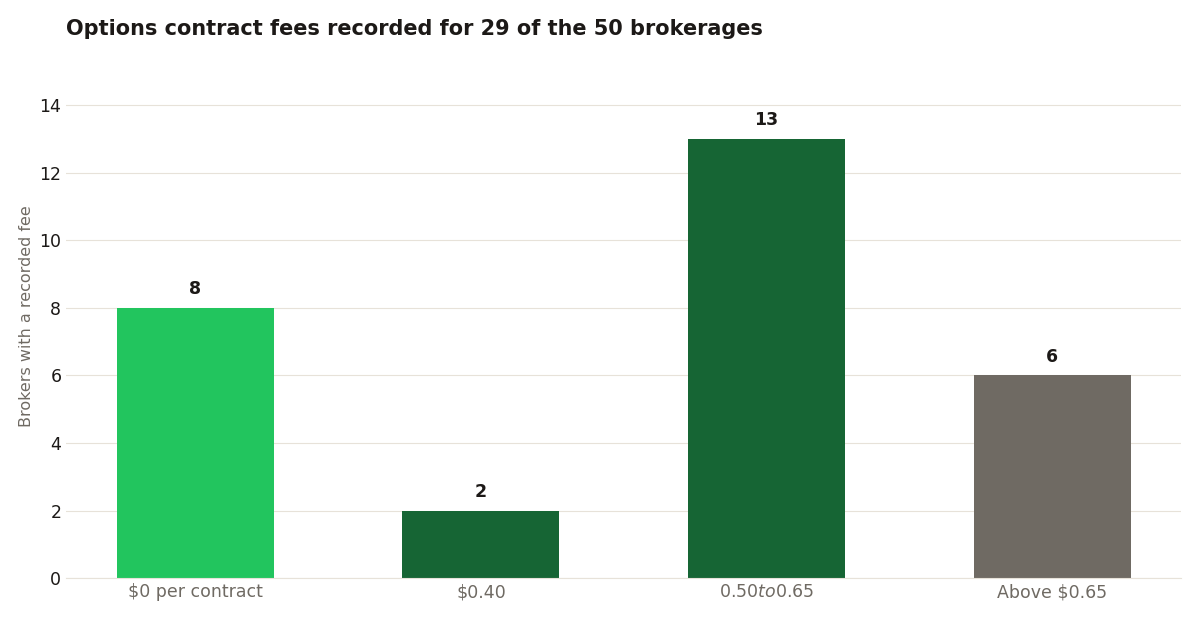
Eight of the 29 record a $0 contract fee: Robinhood, Webull, SoFi Invest, Public.com, moomoo, Firstrade, eToro US and Alpaca Securities. Thirteen sit in the $0.50 to $0.65 band, including Charles Schwab, Fidelity, E*TRADE and Interactive Brokers at $0.65. Six record above $0.65: five at $1.00 (Vanguard, tastytrade, Zacks Trade, T. Rowe Price and U.S. Bancorp Investments) and TradeStation at $0.80. Two, ChoiceTrade and SpeedTrader, record $0.40.
Put volume on it. At 100 contracts a month, the difference between $0.65 and $0 is $65 a month, $780 a year, paid silently per trade. The difference between $1.00 and $0.65 is another $420 a year at the same pace. That is why the contract fee, not the commission, is the number an alert should guard: when a broker moves it by a nickel, an active trader's annual cost moves by hundreds, and the change usually arrives as a quiet schedule update rather than an announcement.
The honest limit of an alert
An alert app can only watch fees that are published somewhere it can read. 21 of the 50 brokerages in our dataset record no options contract fee at all, and a blank in the data means not recorded, not free. If your broker is one of the 21, the first job is not an alert; it is reading the official fee schedule once and writing the number down yourself. The alert then guards your number. The same limit applies to the costs that never print as fees at all, like cash sweep yields and order-flow quality. No push notification will catch a sweep yield quietly sitting at 0.5%, because nothing changed; it was low the whole time. Alerts guard against changes. The starting position is your job, once, at account opening.

The math scales down as well as up. At 20 contracts a month, the gap between the $1.00 brokers and the $0.65 band is $84 a year, and the gap between the band and $0 is $156 a year. Small traders should still set the alert, but they should expect it to pay in awareness rather than dollars: knowing your per-contract price is the difference between choosing a strategy and inheriting one.
Three alerts worth enabling
Margin rate changes: brokers adjust rates as interest rates move, and a 1% hike on $20,000 borrowed is $200 a year you will never notice without an alert. Options fee changes: contract fees and premium pricing tiers shift, and the chart above shows how much room they have to shift into. Transfer and inactivity fee changes: rare, but a new transfer fee changes your switching math overnight, and an inactivity fee charges you for the patience every other lesson recommends. Set those three fee alerts and you have covered the fees that can actually move against you.
Alerts that do not save money
Price alerts on stocks you own, set for the noise. Promotional pushes disguised as insights. Any notification designed to make you trade more. More trading means more fees, which is exactly what the broker wants, and it is the opposite of what the alert was for. Mute everything else. The cheapest notification is the one you never needed because you picked a low-fee broker upfront.
When an alert tells you to move
Sometimes the alert is the last straw: a fee rises, and the math on switching finally wins. Before you act on it, price the exit with the SwitchCost Checker, which builds the cost of leaving your current broker from the same recorded fee data, so a $0.65 problem does not become a $75 transfer mistake. Read it as education, not financial advice. Alerts earn their keep when they catch the one change that matters and stay silent the rest of the year; set three, and let the phone be quiet.