
On October 7, 2026, the US House Select Committee on China published a report on Webull, the app broker whose shares trade on Nasdaq as BULL. Webull disputed the findings, called them significant inaccuracies, and said US customer data is stored and access controlled in the US. The shares fell about 19 percent that day anyway, a class action followed, and within a day three rival brokers had posted the same number in public: 3 percent, paid to any Webull customer who moved an account to them. Every one of those windows has now closed. What follows is the post-mortem: what each offer actually said, what the switch paid at three account sizes, and what it cost on the recorded numbers.
What happened in October
The committee report, titled Free Trades, Hidden Ties, questioned how American Webull's structure really is. This article takes no side in that argument; the economics are the story here. The reaction was the fastest round of rival offers the app broker era has produced: Robinhood and Public posted Webull specific 3 percent transfer matches on October 7 itself, and SoFi joined on October 8. Transfers initiated inside the windows are still settling now, because an ACATS move typically takes 5 to 7 business days, as our transfer fees guide explains. The offers themselves are gone: the last window, Public's, shut on October 26.
The three offers, side by side
All three paid the same headline rate on assets transferred out of Webull. Everything that mattered sat underneath it: the window, the cap, how the money arrives, and what you owe if you leave early.
| Broker | Window, October 2026 | Cap | How the bonus arrives | The hold |
|---|---|---|---|---|
| Robinhood | October 7 to 16 | No cap published | Around settlement | Keep the net transferred value for 5 years, or face a bonus chargeback |
| SoFi | October 8 to 15 | $150,000 bonus, binding at $5,000,000 transferred | Within five business days of settling | Five year earn out; early withdrawals hand back a proportional slice |
| Public | October 7 to 26 | $1,000,000 of transferred value matched, so $30,000 at most | 72 monthly installments over six years | Withdrawals shrink the installments still to come |
Robinhood's terms come from its own offer page, checked on October 28, 2026: transfers that originate from Webull earn a flat 3 percent, the assets had to be transferred before 11:59 p.m. ET on October 16, a transfer initiated in the window could settle after it, and the five year clock runs on the net transferred asset value. Public's terms come from its own Webull match disclosure page, checked the same day, and they are the most engineered of the three: the match is calculated on the value at settlement, paid as 72 equal monthly payments, and reduced if you pull money out before the six years run. SoFi's window closed first and its offer page no longer shows the offer, so its terms here are as tracked by Doctor of Credit and Money at 30 in October 2026: a 3 percent match on brokerage and IRA transfers, paid within five business days of settling, with the bonus earned out over five years.
What 3 percent pays, and what the structure does to it
The arithmetic is the easy part.
- $10,000 transferred: $300, at any of the three.
- $100,000 transferred: $3,000. At Public that arrives as $41.67 a month for 72 months. Public's own worked example makes the pace plain: a $12,000 transfer earns a $360 match, paid as 72 monthly payments of $5.00.
- $1,000,000 transferred: $30,000, which is also where Public's cap stops the meter. SoFi's cap does not bind until $5,000,000 transferred, and Robinhood published no cap.
Now run the same numbers through the holds. Robinhood's $30,000 on a $1,000,000 transfer is 3 percent once, guarded by a five year chargeback: stay the full term and it works out to 0.6 percent a year for not leaving. Public's $3,000 on $100,000 is the same 3 percent headline stretched across six years of installments, and only the installments already paid are safely yours if you leave early. Neither structure is a trick. Both are the price of the headline, and both are invisible if you only read the 3 percent.
The cost side, from the record
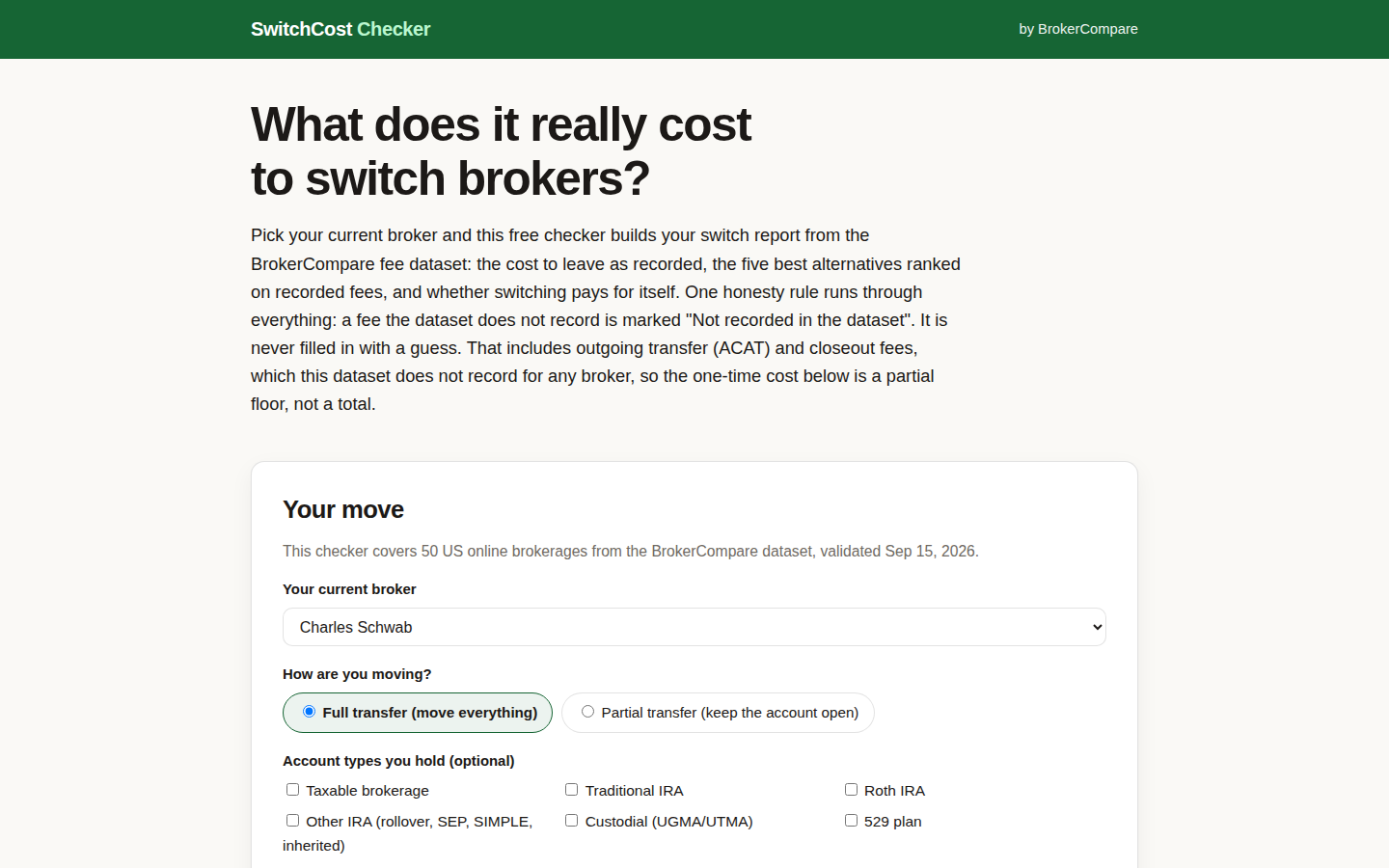
Start with the exit toll. Webull's own pricing page, checked on October 28, 2026, lists $75 per outgoing stock transfer, charged by its clearing firm, Apex. On a $10,000 transfer chasing a $300 match, that single line eats a quarter of the bonus before anything else moves. Our own dataset cannot give you that number: it records no outgoing transfer fee for any of its 50 brokers, which is why the SwitchCost Checker marks the line Not recorded in the dataset, and why the fee above comes from Webull's page rather than our table. Some receiving brokers reimburse transfer fees when you ask before the transfer, not after, as our guide to transfer fees and six more costs sets out.
The yearly costs, as recorded in the BrokerCompare dataset on September 15, 2026, are quieter. Stock and ETF commissions are recorded at $0 at Webull, Robinhood, SoFi and Public, and options contract fees are recorded at $0 at all four as well, so a switch among them changes almost nothing on trading costs. The recorded difference is margin. The dataset records a base tier margin rate for only 16 of its 50 brokers, and among those, Public's recorded 4.9 percent on balances up to $50,000 is the lowest on file. Webull's recorded base rate is 8.74 percent and SoFi's is 9.5 percent. Robinhood's base rate is not recorded in the dataset, so neither the checker nor this article can price a margin move to Robinhood from the record. On a $25,000 margin balance, the recorded gap between Webull at 8.74 percent and Public at 4.9 percent is about $960 a year, every year you carry the balance, set against a one time match. Those are recorded figures from September 15, 2026, not live pricing: margin rates move, and the live schedule at each broker is the one that bills you. Our margin rates by balance tier page is the wider read on how the tiers work.
One more record worth stating: the dataset's promo table holds six recorded offers across all 50 brokers, verified on September 15, 2026, and none of the three October matches is in it, because it predates them by three weeks. A recorded promo is a snapshot. October is what snapshots miss.
The checklist this episode leaves behind
Transfer matches like these will come back; brokers have learned the price of a rival's bad week. When the next one lands:
- Divide the bonus by the hold. Three percent guarded by a five year hold is 0.6 percent a year. Price it that way.
- Lump sum or installments? The same 3 percent paid over 72 months is a different product from the same number paid at settlement.
- Find your cap. Public's bound at $1,000,000 transferred, SoFi's at $5,000,000, Robinhood published none. The cap that matters is the one at your account size.
- Price the exit at the broker you are leaving, from its own fee schedule, and ask the new broker about reimbursement before you initiate anything.
- Compare the yearly costs, not the banner. Run both brokers through the SwitchCost Checker on your real trading picture; a margin balance can outweigh the match inside a year.
- Read the offer on the broker's own terms page. Summaries compressed Public's cap two different ways in October; the disclosure page settled it in one paragraph.
Sources and method
Offer terms are from Robinhood's offer page, Public's Webull Transfer Match disclosure page, and Webull's pricing page, each checked on October 28, 2026. SoFi's offer page no longer displays the expired offer; its terms are stated as tracked by Doctor of Credit and Money at 30 in October 2026. Recorded fees and rates are from the BrokerCompare dataset of 50 US brokers, last verified on September 15, 2026, and are labelled recorded wherever they appear; they are a dated snapshot, not current pricing. All three offer windows were closed before this article was published, and nothing in it is a live offer. This article is educational information about broker pricing, not investment advice.
The order of operations, when the next match lands: run your current broker through the SwitchCost Checker, read the destination's terms page end to end, price the exit on the schedule of the broker you are leaving, and only then do the headline arithmetic.